History and Trends of SRH
 admin
The Long Road to Choice: The Story of Sexual and Reproductive Health and Rights (SRHR)
The story of Sexual and Reproductive Health and Rights (SRHR) is not just about health. It’s a story of humanity’s journey a long struggle to understand the body, challenge taboos, and affirm that control over one’s own body is a fundamental right. It is a story of courage, science, activism, and justice centuries in the making.
1. Before the Words Existed: The Early Centuries of Silence
Long before “SRHR” became a global term, people lived by customs and traditions that dictated how sexuality and reproduction were understood. In ancient societies, knowledge about the body was limited, and much of what people believed came from myths or religion. Fertility was often linked to divine power worshiped in temples, controlled by priests, or tied to marriage laws that favoured men. Women’s bodies were seen as vessels of family honour or tools of procreation, not as their own.
In the medieval period, conversations about sex were even more restricted. Religious doctrines shaped morality, often painting sexual pleasure as sinful. The idea that people could make choices about their own bodies was unheard of. Health systems were rudimentary, childbirth was dangerous, and maternal mortality was painfully common. Yet, amid these restrictions, midwives and healers quietly preserved knowledge about reproductive health knowledge that would later inspire scientific inquiry
2. Science Breaks the Silence: The 19th Century
The 19th century ushered in an age of discovery. Medical science began to demystify the body. Advances in anatomy, obstetrics, and hygiene transformed how reproduction was understood. But while science progressed, society remained conservative. Conversations about sex were still considered shameful. Women had little say in marriage, childbirth, or family size. Access to contraception was restricted or criminalized in many countries.
Still, change was stirring. Reformers like Margaret Sanger in the United States began speaking out about family planning, despite facing arrest for distributing information about birth control. The first birth control clinics emerged in secret, often run by women who risked their freedom to help others take charge of their fertility. Their quiet rebellion planted the seeds of the SRHR movement.
3. Rights Take Shape: The 20th Century Awakening
The 20th century was a turning point. In 1948, the newly formed World Health Organization redefined health as “a state of complete physical, mental, and social well-being,” not just the absence of disease. This broad definition opened the door for reproductive health to be recognized as essential to human welfare.
That same year, the world adopted the Universal Declaration of Human Rights, which declared that all people are entitled to dignity, equality, and freedom principles that later became the backbone of reproductive rights.
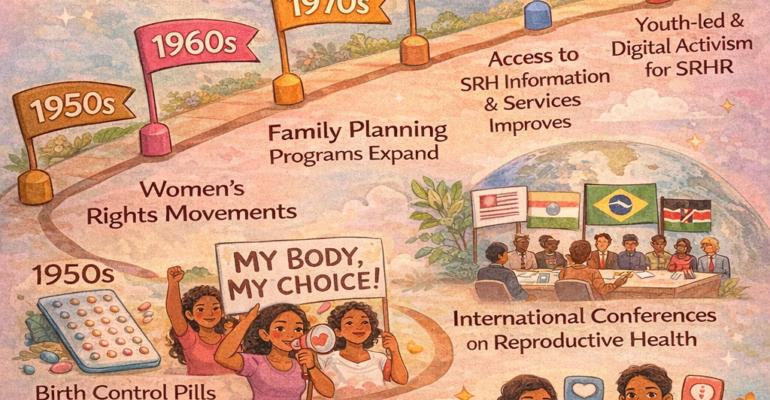
During the 1950s and 1960s, family planning movements spread rapidly. The invention of the contraceptive pill changed women’s lives forever, offering for the first time a reliable method to control pregnancy. Organizations like Planned Parenthood and the International Planned Parenthood Federation (IPPF) pushed governments to recognize that access to contraception was not a luxury but a necessity.
Then came a historic moment in 1968, when delegates from around the world gathered in Tehran for the International Conference on Human Rights. For the first time in history, reproductive rights were explicitly recognized as human rights. It was an acknowledgment that individuals especially women had the right to decide freely and responsibly the number and spacing of their children.
In 1975, the United Nations declared the International Decade for Women (1975–1984), sparking waves of activism around gender equality, reproductive freedom, and women’s participation in development. Across continents, women began to raise their voices in parliaments, in clinics, in classrooms demanding equality not as charity, but as justice.
4. The Cairo Revolution: 1994 and the Redefinition of Reproductive Health
By the 1990s, population control policies had become controversial. Many governments had focused on reducing birth rates rather than empowering individuals. In 1994, something extraordinary happened in Cairo, Egypt. The International Conference on Population and Development (ICPD) brought together over 170 nations, thousands of activists, and civil society leaders who demanded a new vision.
The Cairo conference shifted the global agenda from population numbers to people’s rights and choices. It recognized that sustainable development depends on ensuring that everyone especially women and young people can make free, informed decisions about their sexuality and reproduction. For the first time, terms like “sexual rights” and “reproductive autonomy” became part of global policy language.
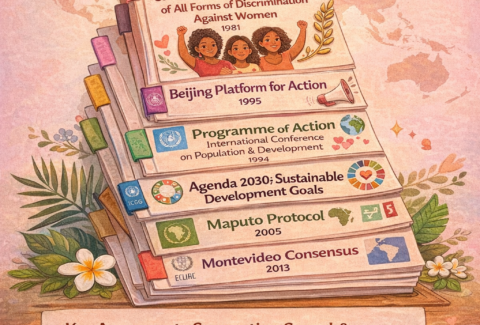
The ICPD Programme of Action became a blueprint for the decades that followed. It called for access to contraception, safe abortion where legal, comprehensive sexuality education, and maternal care all within a framework of gender equality and human rights. It was a declaration that women’s health is not a demographic issue, but a human right.
5. New Challenges, New Movements: The 21st Century
The 21st century began with new energy and new struggles. The HIV/AIDS pandemic had exposed deep inequalities in access to healthcare, information, and justice. Activists across Africa, Asia, and Latin America demanded that governments integrate HIV prevention into reproductive health programs, emphasizing that sexual health cannot be separated from reproductive rights.
In 2012, the London Family Planning Summit reignited global attention on access to contraception, with world leaders pledging to reach 120 million more women and girls by 2020. This marked a new era of international collaboration, blending public health, gender equality, and development goals.
Then, in 2015, the Sustainable Development Goals (SDGs) were adopted embedding SRHR within the global agenda for the first time. Goal 3.7 called for universal access to sexual and reproductive healthcare services, while Goal 5.6 emphasized ensuring universal access to reproductive rights. This alignment meant that SRHR was no longer seen as a side issue it was recognized as central to health, gender equality, and sustainable development.
Despite this progress, challenges persist. In many parts of the world, restrictive laws limit access to safe abortion. Adolescent girls still face stigma when seeking contraceptives. LGBTQ+ persons encounter discrimination in healthcare settings. Gender-based violence remains rampant, often undermining sexual autonomy and reproductive health. But the global movement for SRHR continues to grow driven by activists, young feminists, health workers, and policymakers who believe that no one should be left behind.
6. The Core Principles That Guide the Journey
At the heart of SRHR lies a simple truth: every person has the right to make choices about their body and life without coercion, discrimination, or violence.
It is anchored in human rights, ensuring that health systems respect dignity and autonomy. It is driven by gender equality, recognizing that no society can achieve progress when half its population lacks control over reproduction. And it is guided by the principle of informed choice and consent that individuals must have access to accurate information, safe services, and the freedom to decide.
7. The Unfinished Story
Today, SRHR stands as one of the most transformative movements of our time connecting health, justice, and equality. From the early whispers of midwives in medieval Europe to the global commitments made in Cairo and beyond, this journey reminds us that the right to control one’s body is the foundation of all other rights.
The story of SRHR is still being written — in parliaments where laws are debated, in clinics where young girls seek information, in communities where taboos are being broken. Every new policy, every empowered woman, every educated adolescent adds another chapter.
And as history continues to unfold, one message endures: when people can make free and informed choices about their bodies, they not only change their lives — they change the world